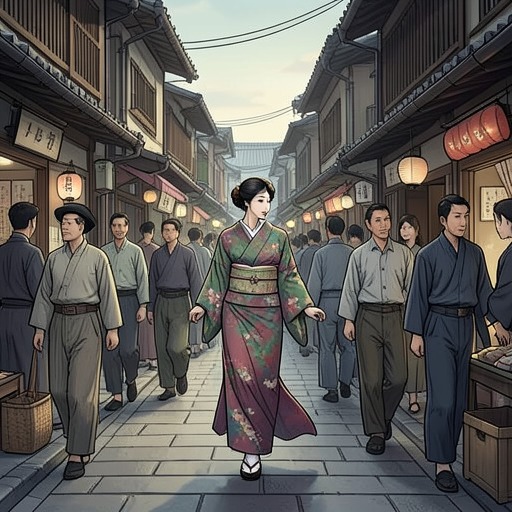
Sayuri’s retirement from Gion
Memoirs of a GeishaSayuri’s retirement from Gion is the cost of becoming the Chairman’s mistress while remaining bound to the consequences of her rupture with Nobu. The Chairman’s negotiations with Mother end her public career without removing her from the Nitta household: Sayuri no longer attends lessons, makes ceremonial calls, or entertains, yet she remains financially tied to the okiya. Her withdrawal grants the Chairman the privacy he wants, but leaves Sayuri in an uneasy middle ground—neither a working geisha nor a wife—and makes her confront what she had lost in pursuing the life she once thought would fulfill her.
The Price of the Chairman’s Favor
Sayuri had long imagined that becoming the Chairman’s mistress would make her life perfect. Instead, she recognizes that driving a painful “barb” from her life does not prevent it from leaving a lasting wound: in banishing Nobu, she loses not only his friendship but also her place in Gion. The loss is tied to a conflict of friendship and possession. A man who receives a prize coveted by his friend must conceal it or risk damaging their bond; Sayuri sees the same pattern in her broken friendship with Pumpkin after her adoption.
The Chairman and Mother negotiate for several months over the arrangement. The Chairman wants Sayuri out of Gion so Nobu will not see her, but he will not marry her because he is already married. A separate teahouse or inn might have offered a solution, but Mother refuses to let Sayuri leave the okiya, since the household would lose the revenue from her relationship with the Chairman. The compromise is a considerable monthly payment from the Chairman to the okiya in return for Mother’s permission to end Sayuri’s career.
What Retirement Changes
Sayuri continues to live in the okiya, as she had for years, but her daily and professional routines cease. She no longer goes to school in the mornings, makes the rounds of Gion to pay respects on special occasions, or entertains in the evenings. Her retirement is therefore not a simple departure from the household: she remains physically within it while withdrawing from the practices that had made her a working member of Gion.
The change exposes the gap between her original purpose and the life she has actually lived. She had entered geisha life to win the Chairman’s affection, so she thinks she ought not to mourn leaving it. Yet years of work have also given her rich friendships with geisha and with men she met through her profession. She is not barred from seeing other women, but those still earning a living in Gion have little time to socialize. Watching two geisha hurry to another engagement and laugh about the previous one, Sayuri envies not their insecure existence but the promise she remembers in an evening that might still hold some mischievous pleasure.
Friendship, Memory, and the Life Left Behind
Sayuri continues to see Mameha several times a week for tea, conscious of how much she owes her for her support since childhood and the special role she played in bringing Sayuri closer to the Chairman. A silk painting of an eighteenth-century woman teaching a girl calligraphy recalls Mameha to her; Sayuri buys it for her as a gift. When Mameha hangs it in her apartment, the present-day room—its stale-tea-colored mats and the medicinal smell from the Chinese pharmacy below—throws into relief Sayuri’s memory of Mameha’s former elegant apartment and the sound of water rushing over the cascade in the Shirakawa Stream. Gion, once like an exquisite antique fabric, has changed along with Sayuri’s life.
The break with Nobu remains emotionally unfinished. Sayuri had hoped he might eventually forgive her, but she has to stop asking Mameha whether he has inquired after her. Mameha’s sigh and sad look make the cost of that hope plain without resolving it: Sayuri has gained the Chairman’s intimate companionship, but cannot recover the friendship her choices damaged.
Private Life Beyond Gion
In the spring after Sayuri becomes the Chairman’s mistress, he buys Eishin-an, a luxurious house in northeastern Kyoto, ostensibly for company guests. In practice, he uses it chiefly to meet Sayuri, three or four evenings a week and sometimes more. Their life there gives her regular companionship with him, but its rhythms are not those of her former public profession: she listens as he clears his mind of the day’s work, then gently turns their conversation toward films, daily incidents, or amusing stories from Mameha.
Retirement thus replaces the public, scheduled life of Gion with a private attachment that is both intimate and constrained. Sayuri can attend to the Chairman and share his evenings, yet she remains outside the geisha community’s working life and carries the consequences of her separation from Nobu. The ending is neither a return to the career she left nor a conventional marriage; it is a negotiated withdrawal, sustained by the Chairman’s payments to the okiya and shadowed by the friendships and possibilities Sayuri can no longer inhabit as before.